
Python is a programming language that is used for software development such as backend (also known as ‘server-side’) web applications, system scripting, and mathematics computations.
It was created in late 1980s but was released in 1991. As a successor to ABC programming language, it was created by a Dutch programmer, Guido van Rossum. He is currently 65 years old this year.
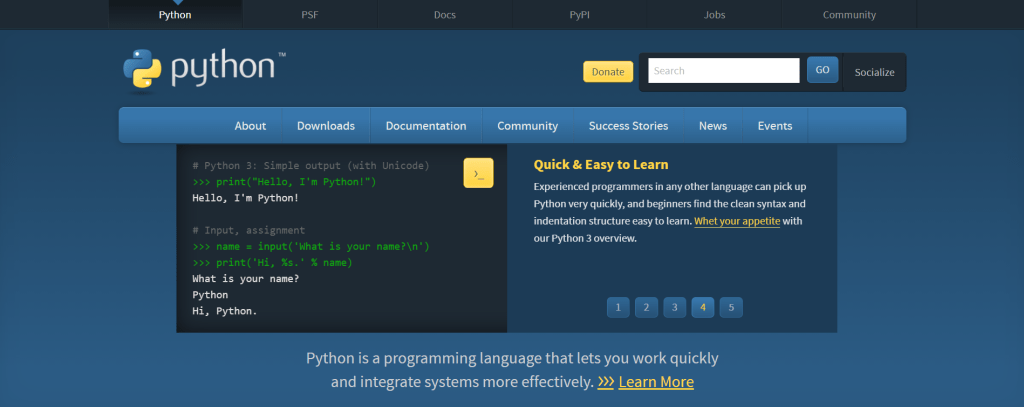
Like other programming languages, it can be connected to a database to access and modify data. Known for its popularity with big data, it is also used to perform complex algorithms (formulas). Moreover, workflows can also be programmed using Python.
To date, Jan 2021, Python 3 is the latest version of Python.
Python can be used with free source-code editor like Visual Studio Code or with Integrated Development Environment (IDE) such as Eclipse, Netbeans, Pycharm or Thonny.
One benefit of Python is it can be used on cross platform such as Windows, Mac, and Linux. The syntax is also closer to native English language and lesser coding required.

Programming with Python:
1. Unlike other programming languages that uses semicolon or parentheses to end a command, Python uses a new line. Thus, just hit the Enter/Return key to close a line!
2. Instead of curly-brackets to open/close loops, classes, and functions, Python uses indentation and whitespaces.
Get Started with Python by installing Python on your computer (local machine)!
 Tech That Matters