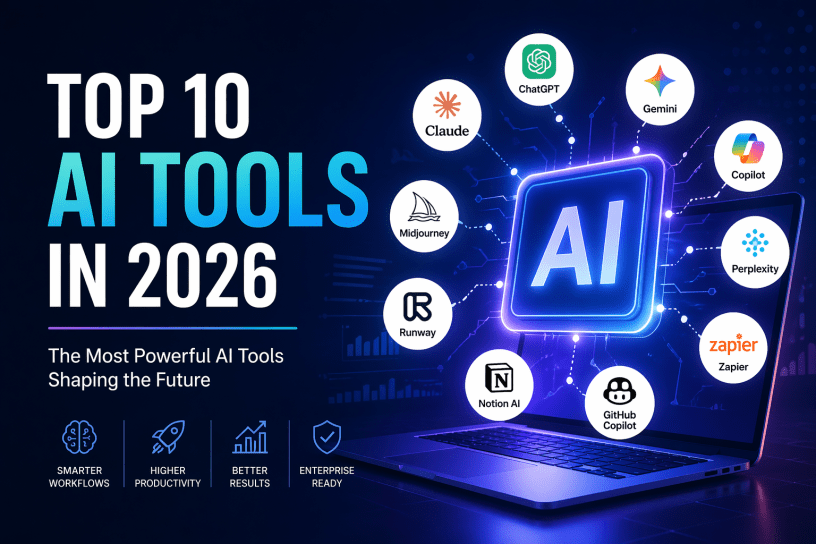
Top 10 AI Tools in 2026 (Latest Market Overview)
The AI landscape in 2026 has shifted from standalone chat tools to integrated ecosystems that support reasoning, automation, content creation, enterprise workflows, and the latest trendy vibe coding (AI-assisted software development through natural language and iterative prompting). Adoption is now mainstream across both consumer and enterprise environments.
1. Claude
- Strong reasoning and long-context capabilities
- Widely adopted in enterprise and compliance-heavy environments
2. GitHub Copilot
- AI coding assistant for developers
- Used for code generation, debugging, and refactoring
3. ChatGPT
- Most widely used general-purpose AI assistant
- Used for writing, coding, analysis, and workflow support
Dominant interface layer in the AI market.
4. Google Gemini
- Integrated into Google Workspace ecosystem
- Used for productivity, search augmentation, and AI agents
Key part of Google’s enterprise AI strategy (Reuters 2026).
5. Microsoft Copilot
- Embedded in Word, Excel, Outlook, and Teams
- Focus on enterprise workflow automation
Major driver of productivity transformation in enterprises (Reuters 2026).
6. Perplexity AI
- AI search engine with cited answers
- Used for research and fact-based answers
- Works well with legal and compliance topics.
7. Midjourney
- High-quality AI image generation
- Popular for marketing and creative production
8. Runway ML
- AI video generation and editing platform
- Supports text-to-video workflows
9. Notion AI
- AI-assisted documentation and knowledge management
- Summarization and structured writing support
10. Zapier
- Automation platform connecting apps and workflows
- Increasingly integrated with AI-triggered automation
The AI ecosystem in 2026 is defined less by individual tools and more by how deeply they integrate into workflows across productivity, automation, and content creation.
Market Direction (2026)
- AI adoption has reached mass-scale deployment across most industries, with ~67%–90% of enterprises using AI in at least one business function and adoption continuing to expand year-on-year (Searchlab 2026; Princeton AI Partners 2026).
- The market has shifted from experimental usage to production-grade deployment, where AI is embedded into core workflows such as customer service, software development, finance operations, and supply chain execution (AI Adoption Statistics 2026; McKinsey/PwC cited studies).
- The dominant transition is from static chat-based tools to autonomous AI agents capable of multi-step execution—planning tasks, calling tools/APIs, and completing workflows with limited human intervention (Reinventing AI 2026; Forbes 2026).
- Multi-agent orchestration is emerging as the standard architecture, where multiple specialized agents collaborate across a workflow (e.g., research → analysis → execution → validation), replacing single-model or single-chatbot designs (Reinventing AI 2026).
- Enterprise adoption is accelerating rapidly, with projections showing up to ~40% of enterprise applications integrating task-specific AI agents by end-2026, a steep increase from under 5% in 2025 (Gartner via industry synthesis).
- Ecosystem integration has become a primary differentiator: AI value is now driven more by integration into enterprise systems (ERP, CRM, cloud platforms, APIs) than by standalone model performance or UI features (Reuters 2026; Adobe Summit 2026 coverage).
- Vendor strategy is converging toward “AI platforms” rather than standalone tools, combining models, orchestration layers, governance, and enterprise security controls into unified stacks (Adobe CX Enterprise 2026; Google Cloud AI Agent ecosystem announcements).
- Security, governance, and identity management are becoming critical constraints due to the rise of non-human AI identities (agents acting autonomously), increasing the need for auditability, permissions control, and safe execution boundaries (Delinea AI Security Report 2026).
- ROI-driven adoption is replacing hype-driven experimentation: organizations increasingly prioritize measurable productivity gains (e.g., time savings, automation rates, cost reduction) before scaling AI systems enterprise-wide (Gartner/Forrester synthesis 2026).

