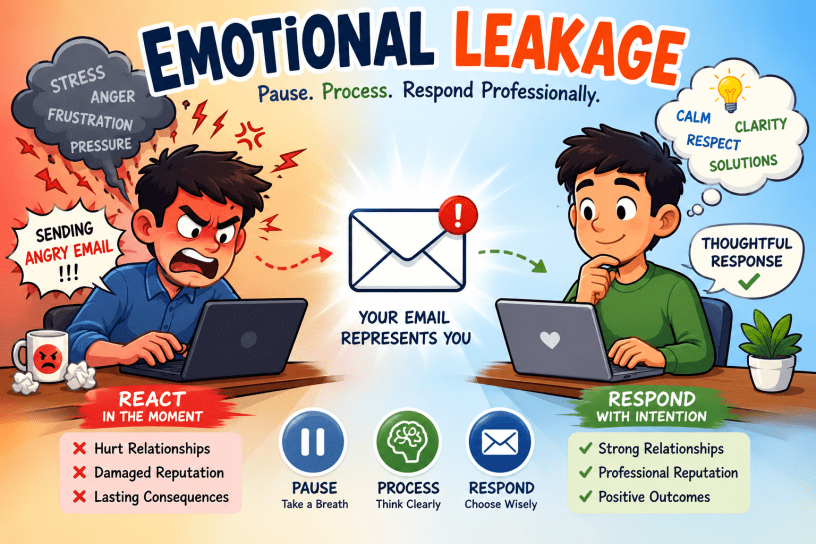
Email remains one of the most critical communication tools in business. From customer support desks and logistics operations centers to executive boardrooms and hybrid work environments, professionals rely on email every day to coordinate decisions, document actions, resolve conflicts, and maintain relationships.
Despite the rise of collaboration platforms such as Microsoft Teams, Slack, and workplace messaging apps, email continues to serve as the official record of communication in many organizations. According to guidance from Microsoft 365, professional email etiquette directly affects trust, collaboration quality, and workplace reputation.
What many professionals underestimate, however, is that email does more than transfer information. It also transfers emotion.
A rushed message.
A sarcastic reply.
An ALL CAPS escalation.
A passive-aggressive follow-up.
These seemingly small behaviors can damage customer relationships, reduce team morale, create compliance risks, and negatively affect professional reputations for years.
One of the most important concepts in workplace communication is something often called “Emotional Leakage.”
What Is Emotional Leakage?
Emotional Leakage occurs when emotions from one situation unintentionally spill into another unrelated interaction.
For example:
- An employee has a stressful argument at home before work.
- A supervisor receives criticism from senior management.
- A frontline staff member handles multiple difficult customers in succession.
- A project manager faces operational pressure during a system outage.
Instead of processing these emotions appropriately, frustration leaks into emails sent to coworkers, vendors, clients, or other stakeholders who had nothing to do with the original problem.
Research discussed by Harvard Kennedy School / Harvard Business Review highlights that anger impairs judgment and increases impulsive reactions. Angry individuals are more likely to rely on emotional shortcuts rather than rational analysis. In workplace communication, this often results in hostile, careless, or overly aggressive emails.
The danger is amplified because email lacks human context.
Unlike face-to-face communication, email removes:
- facial expressions,
- tone of voice,
- body language,
- immediate clarification,
- emotional nuance.
As noted in Harvard Business Review Guides, emotionally sensitive issues are especially difficult to communicate over email because recipients may interpret messages far more negatively than intended.
A short sentence meant to sound efficient may instead appear cold or hostile.
Why Emotional Emails Are Dangerous
Many employees mistakenly believe an emotional email is temporary. In reality, emails are persistent digital records.
An angry email can be:
- forwarded internally,
- escalated to HR,
- archived permanently,
- used in audits,
- referenced during performance reviews,
- exposed during legal investigations,
- included in compliance or disciplinary proceedings.
Purdue University OWL Email Etiquette Guidance specifically warns that email should never contain information or language that could damage someone’s reputation or career because messages can easily be forwarded, copied, or stored indefinitely.
This is especially important in regulated industries such as:
- logistics and shipping,
- healthcare,
- finance,
- government,
- cybersecurity,
- legal services,
- insurance,
- aviation,
- energy.
In these environments, communication records may become evidence during audits, disputes, investigations, or litigation.
The “Send” Button and Emotional Impulses
One of the most dangerous workplace habits is replying immediately while angry.
Modern email systems encourage instant reactions:
- notifications appear immediately,
- mobile devices enable rapid replies,
- remote work increases digital dependency,
- pressure for fast responses creates emotional urgency.
But speed is not always professionalism.
A delayed, thoughtful response is often more effective than an immediate emotional reaction.
Multiple workplace communication experts recommend implementing a “cooling-off period” before replying to emotionally charged emails. Harvard Business Review communication guidance emphasizes that emotionally upsetting emails should rarely receive immediate responses because emotional distance improves judgment and clarity.
This does not mean avoiding accountability or difficult discussions. It means responding strategically rather than emotionally.
Real Workplace Scenarios of Emotional Leakage
1. Frontline Customer Service Scenario
A customer service representative receives repeated complaints from angry customers throughout the day. Near the end of the shift, a polite customer requests a shipment status update.
Instead of responding professionally, the representative replies:
“As already mentioned previously, your shipment is still pending. Please wait.”
The wording may appear technically correct, but the tone sounds irritated and dismissive.
Result:
- Customer satisfaction decreases
- Complaint escalation risk increases
- Brand perception suffers
- Trust deteriorates
A more professional alternative would be:
“Thank you for your patience. Your shipment is currently pending confirmation, and we will continue monitoring the status closely. We’ll update you once additional information is available.”
The information remains the same, but the emotional experience changes completely.
2. Corporate Office Scenario
A project manager faces pressure from senior leadership after a delayed system rollout. Shortly afterward, a junior analyst sends incomplete data.
The manager replies:
“This should have been checked before sending.”
Even if factually accurate, the message may embarrass the employee, reduce confidence, and create fear-based communication culture.
A better response:
“I noticed some fields may still require validation. Could you review and resend the updated version when convenient? Thanks for the effort on this.”
This maintains accountability without hostility.
3. Operations or Logistics Environment
In high-pressure operational environments such as shipping coordination, terminal planning, or supply chain execution, delays and disruptions happen frequently.
Imagine a vessel delay affecting cargo movement. Multiple departments begin escalating issues simultaneously.
An operations coordinator sends:
“We already explained this earlier. Please read previous emails properly.”
This creates friction between departments and may worsen collaboration during critical operations.
A more constructive version:
“For convenience, I’ve summarized the earlier update below regarding the vessel delay and revised timeline.”
Professionalism under pressure is one of the strongest indicators of emotional intelligence in operational leadership.
4. Remote and Hybrid Work Scenario
Remote work introduces another challenge: tone misinterpretation.
Studies and workplace observations increasingly show that short emails are often perceived as passive-aggressive, even when no harm was intended. Workplace discussions highlighted in online professional communities show that employees frequently misread neutral emails because digital communication lacks emotional context.
For example:
“Need this ASAP.”
may feel demanding or hostile.
A better approach:
“Could you prioritize this when possible? We’re working against a tight timeline. Thanks for your help.”
The difference is emotional framing.
Why Being the “Bigger Person” Matters
Professional maturity is not measured by who wins an email argument.
It is measured by:
- emotional control,
- judgment,
- diplomacy,
- professionalism under stress,
- ability to de-escalate tension.
Responding angrily may provide temporary emotional relief, but it often creates long-term professional consequences.
Strong communicators understand:
- not every criticism requires retaliation,
- not every rude email deserves an equally rude response,
- professionalism protects both the individual and the organization.
This is particularly important for leaders. Employees often mirror the communication style of managers and supervisors.
A hostile communication culture spreads quickly.
Best Practices to Prevent Emotional Leakage
1. Pause Before Replying
If emotionally triggered:
- do not reply immediately,
- avoid typing while angry,
- step away briefly,
- review the email later with a calmer mindset.
Even a 15-minute delay can significantly improve tone and clarity.
For highly emotional situations, waiting until the next day may be appropriate.
2. Never Use Email for Heated Arguments
Some discussions should move offline.
If conflict escalates:
- schedule a call,
- use a video meeting,
- speak directly.
Email is poor at handling emotional nuance.
As highlighted in workplace communication guidance discussed by WIRED workplace email etiquette discussion, emotionally sensitive or high-stakes discussions are often better handled outside email entirely.
3. Re-read Emails Before Sending
Before pressing send, ask:
- Does this sound respectful?
- Could this be misunderstood?
- Am I reacting emotionally?
- Would I be comfortable if this email were forwarded to senior management?
This simple habit prevents countless workplace conflicts.
4. Avoid Aggressive Formatting
Avoid:
- ALL CAPS,
- excessive exclamation marks,
- sarcastic wording,
- accusatory phrasing,
- emotionally loaded language.
Guidelines from University of Essex Email Good Practice Guidance and Purdue University OWL specifically caution against capital letters, rude tone, and emotionally charged formatting because they are commonly interpreted as shouting or hostility.
5. Separate Emotion From Professionalism
It is acceptable to feel frustration.
It is not acceptable to weaponize communication.
Emotionally intelligent professionals learn to:
- acknowledge emotions privately,
- process stress constructively,
- communicate professionally regardless of mood.
This distinction is critical for leadership credibility.
Email Professionalism Is Also a Security and Compliance Issue
Professional email behavior is not only about etiquette. It also affects:
- cybersecurity,
- regulatory compliance,
- corporate governance,
- legal defensibility,
- organizational trust.
NIST Trustworthy Email Guidance emphasizes that organizations should treat email as a critical business and security communication channel requiring trust, accountability, and protection mechanisms.
Poorly written emotional emails can:
- create reputational damage,
- increase insider threat risks,
- trigger HR investigations,
- expose confidential information accidentally,
- weaken stakeholder confidence.
In modern organizations, communication professionalism is part of operational risk management.
Quiz & Q&A
1. What is “Emotional Leakage” in workplace communication?
A. Sharing confidential information accidentally
B. Letting emotions from one situation affect unrelated interactions
C. Using too many emotional words in presentations
D. Delaying replies to customers
2. Why should employees avoid sending angry emails?
A. Emails can be permanently stored or forwarded
B. Emotional emails damage professionalism and relationships
C. Angry responses may escalate conflicts further
D. All of the above
3. What is a recommended practice before replying to an upsetting email?
A. Reply immediately to defend yourself
B. Forward the email to coworkers first
C. Wait and cool down before responding
D. Ignore the email permanently
4. Why are emotionally sensitive discussions difficult over email?
A. Emails are automatically deleted
B. Email lacks tone, facial expressions, and body language
C. Email systems reduce message quality
D. Long emails cannot be understood
5. Which behavior demonstrates professional emotional intelligence in email communication?
A. Matching the sender’s anger level
B. Using ALL CAPS to emphasize urgency
C. Responding calmly and constructively
D. Publicly criticizing coworkers through email
Answers Only With Short Explanations
- B — Emotional Leakage refers to emotions from one situation negatively affecting unrelated interactions.
- D — Angry emails can damage relationships, escalate conflict, and remain permanently documented.
- C — Waiting before replying helps reduce emotional reactions and improves judgment.
- B — Email lacks non-verbal communication cues, making tone easier to misunderstand.
- C — Calm, constructive responses demonstrate professionalism and emotional intelligence.
References
- Microsoft 365 Email Etiquette Guidance
- Purdue University OWL Email Etiquette
- Harvard Kennedy School / Harvard Business Review – How Anger Poisons Decision Making
- Harvard Business Review Guides – Writing Resonant Emails
- NIST SP 800-177 Trustworthy Email Guidance
- University of Essex Email Good Practice Guidelines

