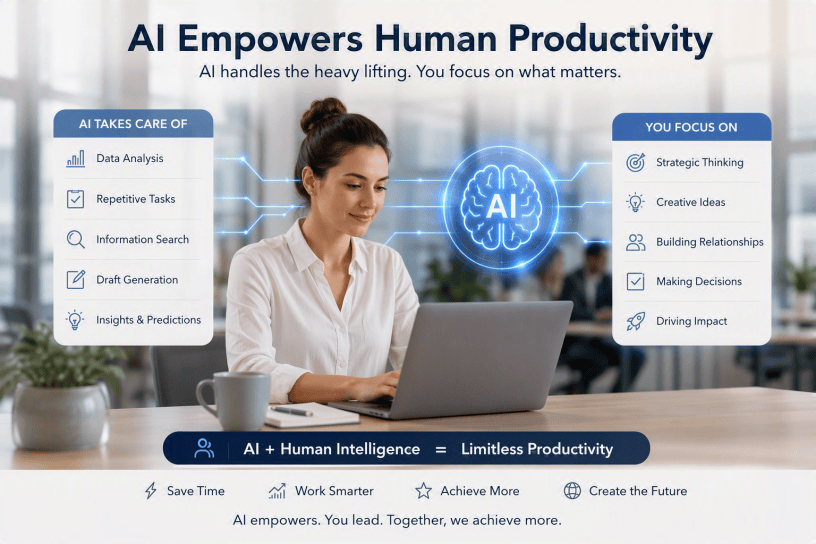
Artificial intelligence may not completely replace people; its core value lies in augmenting human capability. By automating routine tasks, AI frees up time for strategic and creative work, and by surfacing patterns humans might miss, it can support more informed, data-driven decisions. This shift is already visible in tools people use every day — from email to navigation to research — often without users consciously noticing the AI working in the background. (https://www.sciencedirect.com/science/article/abs/pii/S0749596X19300786)
However, to certain extend, AI with workflow automations will replace jobs that require less human interventions. Thus, employees and businesses will need to create new valuable work (with AI) to continue the workforce sustainably.
AI in Everyday Life
AI is embedded in many routine digital interactions:
- Email composition: Gmail’s Smart Compose, launched in 2018, suggests phrases as users type and was used to complete messages 118 billion times in 2022 alone. By 2017, roughly 12% of Gmail messages sent daily — about 6.7 billion messages — were already AI-assisted.
- Navigation and traffic prediction: Google Maps uses machine learning, including Graph Neural Network models developed with DeepMind, to analyze historical traffic patterns combined with live GPS data from millions of devices; its ETA predictions are accurate for over 97% of trips.
- Voice assistants and search: Smartphone assistants use AI to answer everyday questions — weather, recipes, news — by parsing natural language queries and retrieving or generating relevant answers.
Example: A commuter opens Google Maps before leaving home; the app’s ML models, trained on historical congestion data and real-time GPS signals, reroute them around a jam that has not yet fully formed.
AI as a Work Partner
In professional settings, AI functions across three main areas: drafting/editing, data analysis, and brainstorming.
| Capability | What AI does | Example |
| Drafting and editing | Generates text from prompts, flags grammar and structural issues | Compose AI extends Gmail’s Smart Compose with fuller sentence and email drafting |
| Data analysis | Processes large datasets to surface patterns and can visualize results | Hypothetically, a sales manager uploads a quarter’s transaction data and an AI tool flags a regional demand shift before it appears in standard reports |
| Brainstorming | Produces varied idea sets from prompts, drawing on trend data | Marketing teams increasingly use AI for campaign ideation; 72.5% of marketers reported using AI in email campaigns in 2024, with 36.6% citing direct efficiency gains (https://www.jotform.com/ai/agents/gmail-ai-assistant/) |
Using AI Responsibly in Decision-Making
AI is best used to inform and accelerate thinking, not to replace human judgment entirely. Given that even well-adopted AI writing and analysis tools are built on probabilistic pattern-matching rather than guaranteed accuracy, outputs should be checked against domain expertise before being acted on, particularly for high-stakes personal or professional decisions.
For example, a business analyst uses an AI tool to draft a stakeholder update and analyze adoption metrics, but personally reviews the tone, checks the numbers against the source system, and adjusts recommendations based on organizational context before sending — treating AI as a first draft, not a final decision-maker.
The accuracy of AI is highly dependent on the the data used to train the AI models. And you will never know if there are error in the input data from AI companies, especially with high employee attritions. Always verify the AI output with your experience and other trusted sources, including physical books in the libraries.

